 Pommon Labs
The Future of Product (and Knowledge Work)
From doer to reviewer to creator: how AI will change our work, our teams, and the skills we need.
This article is based on a presentation we prepared in late 2024 (with updates in early 2025) on the future of Product Management as a job function. While the presentation was focused on the product function, many of the same insights apply to other types of knowledge work as well. A link to the full presentation is included at the bottom of the article.
In a world of AI, what is the role for team human?
The past twenty years have been an incredible time to work in product. The growth of technology companies brought new roles, frameworks, tools, and communities. Product management became an established career, with specialists working across research, design, engineering, and growth.
AI changes the assumptions behind that model. As more work becomes automated, the next twenty years are unlikely to look like the last twenty. Product thinking may become even more important, while the work of managing and delivering products changes dramatically.
The same question faces researchers, analysts, marketers, consultants, and many other knowledge workers: when AI can do more of the work, where do we contribute?
From doer to reviewer to creator
Most organizations divide work into three activities: setting the vision, reviewing the work, and doing the work. Executives, managers, and individual contributors typically share these responsibilities, and one person may play all three roles.
As AI takes on more execution, human work shifts toward reviewing the output, handling more complex problems, and deciding what to do next. Further ahead, AI may also take on more coordination and review, changing the human role again.
For knowledge workers, the direction is from doer to reviewer to creator. Knowing what to build, why it matters, and how to judge the result becomes increasingly important.
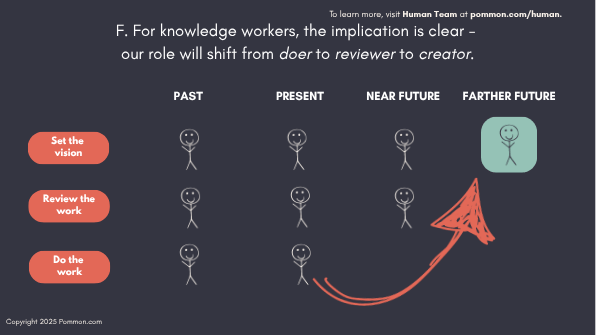
This progression will unfold differently across organizations and professions. It is a way to think about changing responsibilities, rather than a timetable that applies to every job.
Five predictions for the future of work
1. Product delivery will become almost fully automated
AI and automation will extend across the entire product lifecycle: discovery, delivery, and distribution. Research, requirements, design, and development can become parts of a connected workflow, with less manual effort between each step.
Two scenarios emerge. In one, delivery becomes fully automated. In the other, people remain involved while their work shifts toward more complex delivery problems.
The opportunity goes beyond using AI to write a document or generate code. It involves redesigning the process from beginning to end. For other knowledge work, that could mean connecting research, analysis, and the final deliverable, with appropriate checks along the way.
2. Distribution costs will increase exponentially
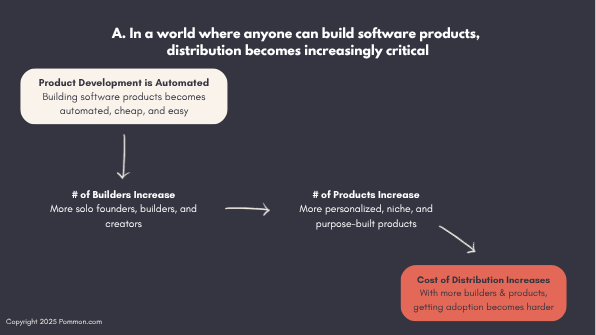
When building software becomes cheaper and easier, more people can build more products. More personalized, niche, and purpose-built products compete for customers. Getting adoption becomes harder. We expect the cost of distribution and reaching mass adoption to increase exponentially as more builders compete for attention.
A distribution-first strategy starts with the people you want to reach. Build an audience, invest in community, and understand how customers will find and adopt what you make.
This applies beyond software. Producing a piece of analysis, a service, or an idea is only part of the job. Getting it into the hands of people who need it requires an understanding of marketing, growth, sales, and trust.
3. Solo founders and full-stack builders will become more common
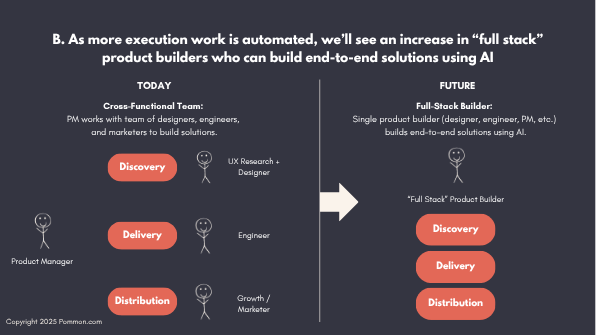
As more execution is automated, a single person can take an idea further across discovery, delivery, and distribution. Product managers, designers, engineers, and marketers can work beyond the boundaries of their traditional roles.
The full-stack product builder brings those activities together, using AI to create an end-to-end solution. Some of these builders will become founders. Others will work in smaller teams or take broader responsibility within an organization.
For individuals, this means learning enough about adjacent disciplines to turn an idea into something people can use. For organizations, it means providing tools and support that help people work across the full process.
4. The death of Agile and other product management frameworks
Our ways of working were designed around human teams and the constraints of manual execution. As product development becomes more automated, teams will likely replace familiar methodologies such as Lean and Agile with more automated ways of planning, prioritizing, and tracking work.
Two-week sprints may give way to continuous development cycles. AI could help generate and test hypotheses, analyze feedback, prioritize features, and identify bottlenecks. Teams will need to reconsider which meetings, handoffs, and routines still improve the work.
Product thinking becomes more important than maintaining a particular product management process. The focus should be understanding the problem, testing ideas, and making good decisions as the work changes.
5. Human skills will become even more critical
As execution and coordination become more automated, communication, influencing, storytelling, and interpersonal collaboration become more consequential.
People need to explain a vision, understand others, resolve disagreement, and build trust. These capabilities matter across product, research, consulting, and other forms of knowledge work. They deserve deliberate practice alongside technical skills and familiarity with AI.
How to prepare
For organizations
Move beyond bolting AI onto existing workflows. Map the work from beginning to end and consider how it could operate with more automation. Decide where human review is necessary and who is responsible for the result.
Invest in tools that support the full process, give people opportunities to work across disciplines, and build communication and collaboration into how teams learn. Think about distribution and community early, rather than leaving adoption until after the product is built.
For individuals
Learn to manage AI-driven workflows through real work. Pick a process you understand, experiment with automating suitable steps, and learn how to evaluate the output.
Build your ability to take an idea from problem to solution. Develop an understanding of how to reach an audience, alongside creative problem-solving and technical skills. Continue investing in communication, influencing, and storytelling.
The full impact of AI will vary by job and organization. Some roles will change substantially, some may no longer be needed, and others will emerge. Preparing means adapting how we work and developing the skills to contribute as those responsibilities change.